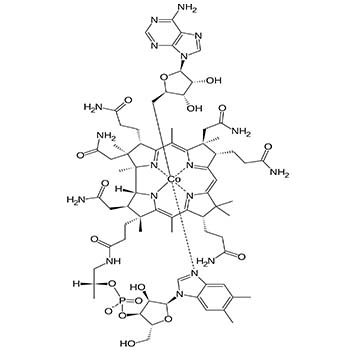
Description
Cobamamide, also known as adenosylcobalamin (AdoCbl), is one of the naturally active coenzyme forms of vitamin B12. Unlike cyanocobalamin or hydroxocobalamin, which require metabolic conversion before they can be utilized, cobamamide functions directly as a coenzyme within cellular biochemical pathways. It is especially critical in mitochondrial metabolism, where it facilitates energy generation and the breakdown of odd-chain fatty acids and certain amino acids. Because of its superior bioavailability and immediate biological activity, cobamamide is highly valued in nutraceutical formulations, clinical nutrition, and functional supplements designed to support energy metabolism and neurological health.
Nutritional Profile
Cobamamide belongs to the cobalamin family of compounds and is recognized as one of the two metabolically active forms of vitamin B12 in the human body, the other being methylcobalamin. As a water-soluble compound, cobamamide serves as an essential coenzyme for several enzymatic reactions, particularly those occurring in the mitochondria. It contributes to the conversion of methylmalonyl-CoA to succinyl-CoA, a key step in the Krebs cycle, thereby influencing the body’s ability to generate ATP. In addition, cobamamide plays an indirect role in the synthesis of hemoglobin and the maintenance of healthy nerve tissue. While present in certain animal-derived foods, its concentration is typically low, making supplementation an important consideration for individuals seeking optimal B12 support.
Phytochemicals and Bioactive Compounds
Although cobamamide itself is not derived from plants and therefore does not contain phytochemicals, it represents a biologically active compound with distinct biochemical significance. As adenosylcobalamin, it is a bioactive derivative of cobalamin that is naturally present in animal tissues, particularly in the liver. Unlike synthetic B12 analogs, cobamamide bypasses enzymatic conversion, delivering immediate functionality in metabolic reactions. Its bioactivity is particularly crucial in neurological tissues, where adenosylcobalamin assists in maintaining myelin integrity and neurotransmitter balance. As a coenzyme, its unique molecular structure enables it to stabilize free radicals formed during enzymatic reactions, ensuring the efficiency and safety of key metabolic processes.
Applications
Cobamamide has a wide range of applications in the nutraceutical and pharmaceutical industries. In dietary supplements, it is used as an advanced form of vitamin B12 that supports mitochondrial energy production, cellular vitality, and cognitive function. Its role in fatty acid and amino acid metabolism makes it particularly relevant for formulations aimed at energy optimization and metabolic health. In addition, cobamamide is utilized in clinical nutrition to address vitamin B12 deficiencies that may arise from malabsorption, gastrointestinal disorders, or dietary restrictions. Beyond deficiency management, cobamamide is increasingly being incorporated into formulations targeting fatigue, neurological well-being, and overall cellular function. Its stability and direct coenzyme activity make it a preferred choice in high-quality supplement blends and injectable forms where rapid biological activity is desired.
Summary
Cobamamide, or adenosylcobalamin, stands out as a bioactive coenzyme form of vitamin B12 that plays a direct role in mitochondrial energy metabolism and neurological health. Unlike synthetic B12 forms requiring conversion, cobamamide is immediately functional within critical enzymatic pathways, supporting ATP generation, fatty acid breakdown, and nerve tissue maintenance. Its superior bioavailability and direct action have made it an essential ingredient in advanced nutraceutical and clinical formulations. With its central role in metabolic and neurological processes, cobamamide continues to be recognized as a highly valuable nutrient for promoting energy, vitality, and cellular balance.